


Different Proxy Types Explained
Different Proxy Types: Complete Guide to Proxy Servers, Protocols, and Use Cases
Introduction
Choosing the right proxy is not as simple as picking any random IP from a provider. Each proxy type has its own rules, limits, strengths, and ideal use cases. When you understand these differences, you save money, avoid bans, improve performance, and protect your privacy far more effectively.
At ProxySocks5, we work with users who run everything from competitive research to e-commerce automation, SEO tools, social media accounts, and global browsing. One thing becomes clear very quickly: choosing the right proxy type makes or breaks your project.
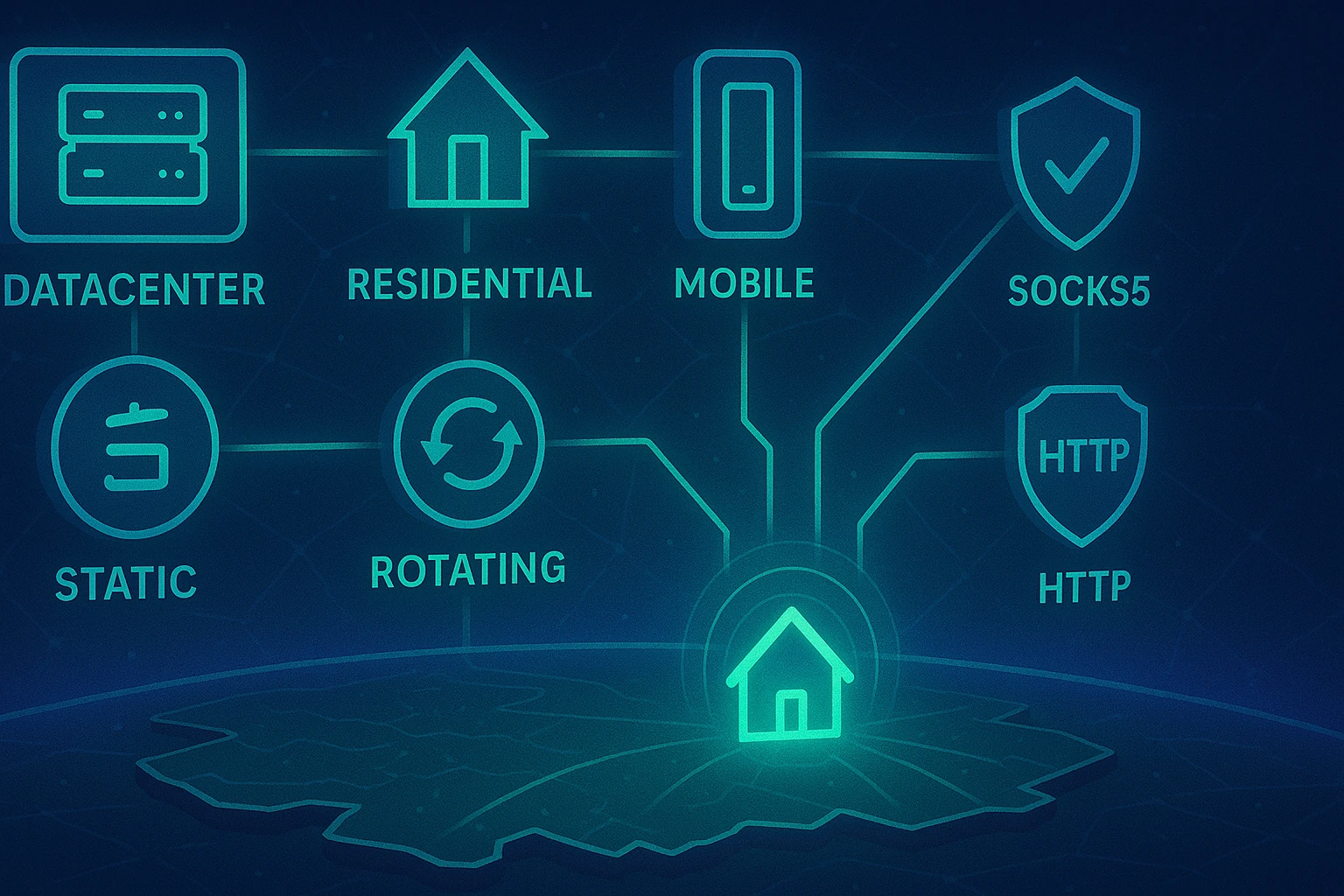
This guide breaks down the different proxy types—datacenter vs. residential, static vs. rotating, dedicated vs. shared, and protocols like HTTP, SOCKS5, Shadowsocks, Trojan, and DNS. You’ll see exactly how each one works and when you should use it.
What Are Proxy Servers?

A proxy acts as an intermediary between your device and the internet. Instead of connecting directly to a website, your request passes through a proxy server, which forwards the request using its own IP address.
This gives you:
- A hidden real IP
- Location flexibility
- Access to blocked or region-locked content
- Better control over automation or multi-account workflows
- A layer of anonymity and safety
Different proxy types achieve these results in different ways, and choosing the wrong one can lead to:
- IP bans
- Slow speeds
- CAPTCHAs
- Broken sessions
- Account locks
That’s why understanding the different proxy types matters.
Proxy Types by IP Source
Datacenter Proxies
Datacenter proxies come from cloud hosting providers, not internet service providers (ISPs). They offer:
- High speed
- Low cost
- Large IP pools
- Fast scaling for automation
But because they do not come from real residential networks, many websites can detect them.
Best Use Cases for Datacenter Proxies
- SEO tools
- Large-scale scraping
- Price monitoring
- Competitive research
- Bulk tasks where speed matters more than authenticity
Limitations
- Higher chances of bans on strict websites
- Sometimes flagged immediately by social platforms
Residential Proxies
Residential proxies use IPs from real ISP-issued connections. This makes your traffic appear like a normal home user.
Benefits
- Extremely hard to detect
- Ideal for websites with strict security
- High trust level
Best Use Cases
- Social media account management
- E-commerce platform automation
- Market research
- Ad verification
- Avoiding blocks and CAPTCHAs
Limitations
- More expensive
- Slower connection speeds compared to datacenter proxies
Static vs. Rotating IP Proxies
Static IP Proxies
A static proxy gives you one dedicated IP that never changes. This is crucial when platforms require consistent identity and login patterns.
Best For:
- Social media accounts
- E-commerce accounts (Amazon, eBay, Etsy, Shopify)
- Banking or high-security logins
- Long-term automation
- SEO rank tracking
Why Static IP Helps
Many platforms flag account logins from changing IPs as suspicious. A static residential or static datacenter IP solves that.
Rotating IP Proxies
A rotating proxy gives you a new IP address automatically at intervals or per request.
Best For:
- Heavy web scraping
- Avoiding IP rate limits
- Multi-threaded automation
- Large datasets collection
Rotating proxies mimic thousands of users accessing a site, so they are ideal when scale matters more than session consistency.
Dedicated vs. Shared Proxies
Dedicated Proxies
A dedicated proxy is used only by you—never shared with other customers.
Advantages:
- Higher reliability
- Better speed
- No IP contamination
- Lower risk of bans
Dedicated IPs are the gold standard for account management, automation, and any sensitive task.
Shared Proxies
Shared proxies are used by multiple users at the same time.
Advantages:
- Lower cost
- Good for low-risk tasks
- More accessible for beginners
Downsides:
- Slower performance
- Higher risk of ban due to other users’ behavior
- Not reliable for long-term sessions or accounts
Proxy Types by Protocol
Different proxy types use different communication protocols. This determines what kind of traffic they support and how secure they are.
HTTP Proxies
HTTP proxies handle only web traffic (HTTP/HTTPS).
Pros:
- Easy to configure
- Fast for browsing
- Works in all browsers
Cons:
- Limited to web traffic
- Not ideal for gaming, VoIP, or torrenting
- Easily detectable by websites
Use HTTP proxies only when your tasks involve normal browsing or testing web content.
SOCKS5 Proxies
SOCKS5 is a flexible, high-performance protocol that works with nearly any type of traffic—TCP and UDP.
Why SOCKS5 Is Better
- Supports all applications
- Works with browsers, apps, games, bots, and scripts
- Minimal traffic modification → harder to detect
- Lower latency
- Supports authentication
Perfect For:
- Automation tools
- Bots
- Anti-detect browsers
- Scraping
- Gaming
- Streaming
SOCKS5 is the backbone of ProxySocks5 because of its unmatched versatility.
Trojan Proxies
Trojan is a proxy protocol that disguises traffic as HTTPS. It is extremely hard to detect or block.
Benefits:
- Stealth browsing
- High encryption
- Bypasses DPI (deep packet inspection)
- Works in restrictive countries
Trojan is ideal when privacy and unblocking ability are the primary goals.
Shadowsocks Proxies
Shadowsocks is a proxy protocol originally built to bypass censorship.
Strengths:
- Lightweight
- Fast even under censorship
- Harder to block than traditional proxies
- Great for streaming or browsing in restricted environments
DNS Proxies
A DNS proxy intercepts DNS queries and forwards them through a specific server.
Best For:
- Bypassing geo-restrictions
- Filtering domains
- Speeding up domain resolution
- Network-wide content control
DNS proxies do NOT hide your IP—so they should be used with other proxy types for privacy.
When to Use Each Proxy Type
Here’s a quick overview to help you pick the right one instantly:
| Use Case | Best Proxy Type |
|---|---|
| Managing social media accounts | Static Residential / Static Datacenter |
| Web scraping (high volume) | Rotating Datacenter / Rotating Residential |
| E-commerce, Amazon, Shopify bots | Static Residential |
| SEO rank tracking | Static Datacenter |
| Bypassing censorship | Trojan, Shadowsocks |
| Multi-account management | SOCKS5 + Static IP |
| Streaming geo-restricted content | Residential Proxy, Shadowsocks |
| Mobile app testing | Mobile Proxies |
| Gaming with low ping | Datacenter SOCKS5 |
Conclusion
Understanding different proxy types is the key to choosing the right tool for your workflow. Whether you're managing accounts, scraping data, running bots, or trying to bypass restrictions, selecting the correct proxy type determines how smoothly your operation will run.
At ProxySocks5, we provide datacenter proxies, residential proxies, static IPs, rotating IPs, and industry-leading SOCKS5 options—built for stability, anonymity, and performance.
When your tools depend on reliable connections, choosing the right proxy is not optional—it’s essential.
FAQ
1. What are the main different proxy types?
The main proxy types include datacenter, residential, mobile, static IP, rotating IP, dedicated, shared, and protocol-based types such as HTTP, SOCKS5, Trojan, Shadowsocks, and DNS proxies.
2. Which proxy type is best for avoiding bans?
Residential proxies offer the highest trust level and are the hardest for websites to detect, making them ideal for avoiding bans on strict platforms.
3. What is the difference between static and rotating proxies?
Static proxies keep the same IP address at all times, perfect for account management. Rotating proxies change IPs frequently and work best for scraping and high-volume tasks.
4. Are SOCKS5 proxies better than HTTP proxies?
SOCKS5 proxies support all types of traffic, offer better performance, and are harder to detect, making them more versatile than HTTP proxies.
5. When should I use Trojan or Shadowsocks?
Trojan and Shadowsocks are best for bypassing censorship, DPI blocking, and accessing restricted content when privacy and unblocking ability are top priorities.

Buy Proxy, SOCKS5 & ShadowSocks Now
Buy Proxy now HTTP Proxies or SOCKS5, Dedicated or Shared, Residential or Datacenter. Fully Anonymous and Premium.
Buy Proxy


What Can We Offer You?
We offer a unique proxy infrastructure, monitored 24/7 with a 99% uptime. In the rare event of a failure, we take immediate action to resolve the issue.
Fast HTTP Proxies and SOCKS5
Our proxy servers are optimized for performance, powered by a 1Gb/s network. Whether you use our residential or datacenter proxies, you'll experience seamless performance.
Proxies with Unlimited Bandwidth
Our Dedicated, Shared, Residential Proxy, SOCKS5, Shadowsocks, and VPNs offer unlimited bandwidth, allowing you to use them as much as you need without any concerns.
Instant Activation Proxies: Plug & Play
Purchase proxies with Instant Activation using a Card or PayPal. Transactions with cryptocurrencies require network confirmations.
Multiple Payment Methods: From Card to Crypto
Buy proxies with Card, PayPal, Bitcoin (BTC), Bitcoin Cash (BCH), Ethereum (ETH), Litecoin (LTC), Solana (SOL), Monero (XMR), Polygon(POL), Tron (TRX), AVAX, USDT, USDC, DAI, DASH, DOGE, TON.
Choose Your Proxy by Country, State, or City
Select proxies by city, state, or country. Our static IP proxies, VPNs, residential or datacenter, can be filtered by your desired location. Residential proxies can also be filtered by ISP.
Dual Authentication
Opt for username and password authentication, or authenticate by adding your IP address to our system. Access your proxy password or add your IP in your account.
Monthly IP Address Refresh
We offer monthly proxies, both residential and datacenter. For long-term purchases, we provide the option to change proxies directly in your account.
Proxies Focused on Top Privacy & Security
Our static proxies and VPNs (residential or datacenter) ensure 100% anonymity without any IP or DNS leaks. We maintain a no-logs policy.
Affordable Prices, High-Quality Proxies
Our Residential and Datacenter Proxies are competitively priced, ensuring affordability without compromising on quality.
Diverse Proxy Services and VPNs
As a leading proxy provider, we offer 13 services, including Residential and Datacenter Proxies, SOCKS5, Shadowsock, and VPNs, available in static or rotating options.
16/7/365 Technical Support
We understand the importance of support. If you have questions about our services, contact us via Live Chat. For any issues, open a support ticket in your account.
User-Friendly Settings
Our dashboard is easy to use and intuitive. We constantly seek ways to enhance user experience. If you need assistance, contact us and we'll gladly help!
Our Services
We offer a variety of static and dynamic IP solutions designed for legitimate business and technical use, with global coverage tailored to your project requirements.








High quality & private proxies
Dream no more! Get acquainted with our products today: protected proxy-servers, at incredible speed and minimum cost from you. Still not convinced? Check our proxies features out: - work with any sites/programs - supports HTTP/HTTPS, SOCKS5, ShadowSocks, Trojan protocols - simple login: your proxy password or by your IP
With our proxies you get fast, stable and most important, an anonymous tool to get by on the internet. High quality proxies is our motto. Try our products today: spare 5 minutes from your time to gain continuos work-flow.
Buy Proxy